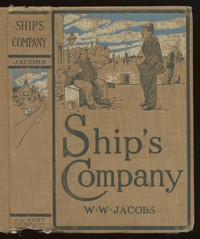
Watch-Dogs Ship's Company, Part 5. — Text and Context

(0 User reviews)   1113
Jacobs, W. W. (William Wymark), 1863-1943, Owen, Will, 1869-1957 [Illustrator] Project Gutenberg 2004 Not confirmed
Humorous stories, English; England -- Social life and customs -- Fiction Readers of public-domain and historical texts
Project Gutenberg digital edition en

Edition facts

Words 7,032
Reading time 31 min
Text sections 1

Before opening Watch-Dogs Ship's Company, Part 5. — Text and Context, the edition data offers a quick orientation: 7,032 words, 31 min estimated reading time, and 1 detected text section.

The text analysis averages about 18.5 words per sentence, while the detected sections provide another way to judge how the source is divided.

Project Gutenberg metadata also associates the work with “Humorous stories, English,” connecting these edition facts with the source record’s subject description.

In 'Watch-Dogs,' the oldest inhabitant of Claybury recounts Bob Pretty's con of a visiting animal-lover, using a dog bite to win a gold watch. Jacobs' dialect-rich narrative and ironic humor emerge through the storyteller's voice, framing a tale of rural cunning.
Share
Editorial Edition Score 4.4/5

Calculated from edition completeness, EPUB availability, text structure and catalogue metadata. Not a user rating.

How this score is calculated
  • Description quality20 pts
  • Title & short description10 pts
  • Source metadata20 pts
  • Text length15 pts
  • Chapters / structure15 pts
  • EPUB file integrity20 pts

Total of 100 points, scaled to a 2.5-5.0 range. Editions with an empty description or a missing EPUB file are not scored.

Edition quality

Public-domain source text

Read the source text

The source text is kept in the dedicated reader, separate from this catalogue record and its commentary.

The oldest inhabitant of Claybury holds forth at the 'Cauliflower' public-house, his monologue framed by a slow draught of beer and a pipe lit with 'infinite care.' His opening remark—that kindness to animals is all very well, but kindness to fellow-creatures is more—sets up a tale that will invert that sentiment entirely. The story he tells, about a London gentleman named Mr. Bunnett who offered a prize for kindness to animals, becomes a vehicle for the narrator's wry commentary on human nature and the local rogue Bob Pretty.

The Storyteller's Voice and Setting

The narrative is delivered entirely in the oldest inhabitant's dialect, a thick rural speech that shapes every observation. His digressions—such as the complaint that beer and tobacco 'don't want chewing' when you have no teeth—establish a persona both crafty and self-deprecating. The setting at the 'Cauliflower' elms, with the landlord silently refilling his mug, reinforces the oral tradition: this is a tale told over ale, meant to be savored slowly. Jacobs uses the frame to distance the reader from the action, filtering Bob Pretty's schemes through a narrator who admires the rogue's cleverness even as he pretends to moralize.

Bob Pretty's Method: Exploiting Sentiment

Bob Pretty, described as 'the biggest raskel Claybury 'as ever had,' operates by manipulating Mr. Bunnett's well-meaning but naive animal-love. When Bunnett offers a gold watch for kindness to animals, Bob stages a scene: his dog Joseph seizes Bunnett's leg, and Bob feigns helplessness, claiming he cannot 'hurt his feelings' by ordering the dog off. The comedy lies in Bob's pretense of concern—'P'r'aps if you keep quiet he'll leave go'—while Bunnett panics. Bob extracts the watch by making Bunnett promise it in exchange for hitting the dog, a transaction that parodies the prize's original intent.

The Role of the Dog Joseph

Joseph is more than a prop; he is a trained accomplice. Bob's command—'Come off, Joseph, old boy, there's a good doggie. That ain't a bone'—shows the dog responds to cues, waiting for the signal to release. The dog's 'best mouth' (a gentle grip that doesn't break skin) is a detail that underscores Bob's calculation. Jacobs uses the animal to blur the line between instinct and training: Joseph's obedience is both a joke and a tool. The dog's silence and stillness contrast with Bunnett's shouting, heightening the absurdity of Bob's claim that noise 'excites' the animal.

The Prize and Its Aftermath

Bob wins the watch and then proceeds to the 'Cauliflower' to collect money he had wagered on the outcome. The landlord, Smith, 'put in outside for it,' meaning he refused to pay—a hint that Bob's reputation precedes him. The story ends not with Bob's triumph but with the community's resistance: Bill Chambers makes a speech that 'didn't do Bob Pretty the good it ought to ha' done.' This coda suggests that while Bob may outwit outsiders, the locals are not so easily fooled. The tale thus balances admiration for the con with a quiet assertion of communal skepticism.

Readers approaching 'Watch-Dogs' should attend to the frame: the oldest inhabitant is not a neutral reporter but a performer who shapes the story for his audience. His asides—about the wasted beer, the landlord's withdrawal—are part of the performance. Jacobs leaves the moral ambiguous: is Bob a villain or a folk hero? The answer lies in the telling, not the tale. Let the dialect guide you; it is the true subject of the piece.

This tale of Bob Pretty’s sly theatrics reminded me of the storyteller’s own quiet glee in Fine Feathers—that same patient relish for watching vanity trip over itself. I remember reading both on a damp afternoon, feeling less alone in my own fondness for the crooked. That knowing smile lingers. Fine Feathers Ship's Company, Part 1. — Themes and Context holds a similar warmth, like an old porch remembered.

There are no reviews for this eBook.

0
0 out of 5 (0 User reviews )

Add a Review

Your Rating *
There are no comments for this eBook.

Reader reflection

Record your reading impressions

A brief reflection can help important ideas stay with you longer.

Your progress 0 / 10
1

Have you finished this book?

2

Did this book hold your interest?

3

Is this a title you would suggest to others?

4

How easy was the book to follow?

Related eBooks