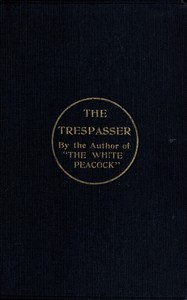
The Trespasser — Key Ideas to Explore
Edition facts
Before opening The Trespasser — Key Ideas to Explore, the edition data offers a quick orientation: 75,635 words, 5 hr 29 min estimated reading time, and 33 detected text sections.
The text analysis averages about 12.3 words per sentence, while the detected sections provide another way to judge how the source is divided.
Project Gutenberg metadata also associates the work with “Adultery -- Fiction,” connecting these edition facts with the source record’s subject description.
Calculated from edition completeness, EPUB availability, text structure and catalogue metadata. Not a user rating.
How this score is calculated
- Description quality20 pts
- Title & short description10 pts
- Source metadata20 pts
- Text length15 pts
- Chapters / structure15 pts
- EPUB file integrity20 pts
Total of 100 points, scaled to a 2.5-5.0 range. Editions with an empty description or a missing EPUB file are not scored.
Public-domain source text
Read the source text
The source text is kept in the dedicated reader, separate from this catalogue record and its commentary.
The novel opens not with its lovers but with a dispute over a violin mute. Louisa, a friend, objects to Helena's muted playing; Helena replies that unmuted sound would be 'simply unendurable.' This small clash introduces a pattern of tension between restraint and expression that runs through the book. The setting—a 'mean house' in South London, its green walls and polished floor like 'a square of grass in a setting of black loam'—is rendered with Lawrence's characteristic attention to domestic space as psychological atmosphere. A young man reclines by the fire, 'evidently at his ease, yet he seemed a stranger in the room.' That stranger is Siegmund, and the room is Helena's, filled with mementoes and a small soapstone Buddha. The opening establishes a world of aesthetic refinement and emotional constraint, where music mediates feeling and objects carry symbolic weight.
The Weight of a Single Day
The excerpts concentrate on a single day—the last morning of Siegmund and Helena's holiday on the Isle of Wight. Lawrence uses the compressed timeframe to intensify the emotional stakes. Siegmund is 'at the bitter point of farewell'; he sees 'beyond the glamour around him, the ugly building of his real life.' Helena, by contrast, is radiant, asking if he noticed the waves 'like a line of children chased by a white dog.' The gap between their perceptions is stark. Siegmund refrains from speaking his heart: 'It is my last morning; it is not yours.' The narrative voice stays close to his interior, recording what he suppresses. Helena, meanwhile, feels 'the responsibility of this holiday'—she proposed it, insisted on it, and paid for it. Their dialogue is full of small misalignments: she asks if he had a good time swimming; he replies briefly. The reader watches two people occupying the same scene but different emotional realities.
Gestures That Speak Louder Than Words
Lawrence builds meaning through physical actions and sensory details. When Siegmund stoops to kiss Helena, he 'remained moving his hand in the pool, ashamed, and full of contradiction.' The hand in the water, the averted gaze, the shame—these carry more than the spoken words. Later, Helena washes her feet in a pool and holds them to Siegmund to dry, a gesture of intimacy that also suggests dependence. When he takes her in his arms, his face is 'muffled in the shoulder of her dress'; he can 'smell her fresh and fine from the sea.' The sensory detail—smell, touch, the texture of fabric—grounds the emotion. Even the breakfast scene with Mrs. Curtiss is built around small physical cues: Siegmund 'swaying from one leg to the other,' 'whistling without making any sound.' These repeated gestures of discomfort reveal his unease in the role of 'accepted swain.' Lawrence trusts the body to express what words cannot.
The Island as a World Apart
The Isle of Wight setting functions as a temporary sanctuary, insulated from the mainland life Siegmund must return to. The sea is described as 'wonderful,' the morning 'perfect,' but these descriptions are undercut by Siegmund's awareness that they belong to a borrowed time. Helena says, 'It would be too much for life to give. We have had something, Siegmund.' She frames the holiday as a gift, a finite experience. The landscape itself becomes a witness to their parting: 'the sea is enjoying the joke, and you are full of delight,' Siegmund thinks bitterly. Lawrence uses natural imagery to mirror emotional states without heavy-handed symbolism. The pool where Helena washes her feet, the 'little bay' Siegmund swam to, the mention of the three-forty-five train—all anchor the idyll in concrete details that also mark its limits. The island is not a fantasy but a real place with a schedule, a train, a return ticket.
The Unseen Life Waiting Offstage
Though the excerpts focus on the holiday, the novel's full title—The Trespasser—and the catalog subject 'Adultery' point to a larger structure. Siegmund is a married man; his wife and children exist offstage, referenced only obliquely. When Helena says 'I did well, didn't I, Siegmund?' she claims ownership of the holiday's success, but the question also hints at the moral trespass. Lawrence does not moralize directly; instead, he lets the emotional cost accumulate through Siegmund's 'misery' and 'contradiction.' The reader is given only fragments of the 'ugly building of his real life,' but those fragments are enough to suggest the weight he carries. The novel's thirty-one chapters likely trace the affair from its inception through its consequences, but the excerpts offer no resolution. The reader must attend to the gaps—what is not said, what is only felt—as much as to the vivid present moments.
Reading The Trespasser requires patience with its interior focus and its willingness to let a single day unfold over many pages. Lawrence's method is cumulative: small gestures, suppressed thoughts, and sensory details build a portrait of a relationship under the pressure of its own ending. The novel rewards attention to what is withheld—the unspoken words, the averted glances, the objects that carry memory. Approach it not as a plot-driven story but as a study in emotional geometry, where the space between two people is as important as their moments of contact.
The rain slid down the window as I turned the last page of The Trespasser, haunted by how Helena’s music held Siegmund in a half-life. That ache of unspoken things stayed with me. Later, reaching for something else, I found Fairy Gold Ship's Company, Part 4. — A Closer Reading among the shelves, and its quiet, salt-stained cadence felt like the shore after that storm.
There are no reviews for this eBook.
Record your reading impressions
A brief reflection can help important ideas stay with you longer.