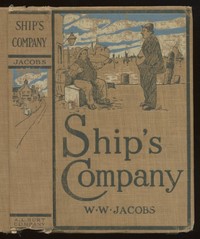
Fairy Gold Ship's Company, Part 4. — A Closer Reading

(0 User reviews)   184
Jacobs, W. W. (William Wymark), 1863-1943, Owen, Will, 1869-1957 [Illustrator] Project Gutenberg 2004 Not confirmed
Humorous stories, English; England -- Social life and customs -- Fiction Readers of public-domain and historical texts
Project Gutenberg digital edition en

Edition facts

Words 7,033
Reading time 31 min
Text sections 1

This digital edition of Fairy Gold Ship's Company, Part 4. — A Closer Reading is described by source-level measurements including 7,033 words, 31 min estimated reading time, and 1 detected text section.

The text analysis averages about 14.5 words per sentence, while the detected sections provide another way to judge how the source is divided.

Project Gutenberg metadata also associates the work with “Humorous stories, English,” connecting these edition facts with the source record’s subject description.

In this comic tale of hidden savings and mutual suspicion, W. W. Jacobs follows the schemes of Mr. Augustus Teak and his friend Mr. Chase as they try to outwit each other over a secret hoard of three hundred pounds. The story's humor arises from their elaborate deceptions and the ironic twist that the wife has already moved the money.
Share
Editorial Edition Score 4.4/5

Calculated from edition completeness, EPUB availability, text structure and catalogue metadata. Not a user rating.

How this score is calculated
  • Description quality20 pts
  • Title & short description10 pts
  • Source metadata20 pts
  • Text length15 pts
  • Chapters / structure15 pts
  • EPUB file integrity20 pts

Total of 100 points, scaled to a 2.5-5.0 range. Editions with an empty description or a missing EPUB file are not scored.

Edition quality

Public-domain source text

Read the source text

The source text is kept in the dedicated reader, separate from this catalogue record and its commentary.

W. W. Jacobs's 'Fairy Gold' opens with a conversation that immediately establishes its comic tone: Mr. Augustus Teak, described by his friend as 'all brains,' maneuvers the larger Mr. Chase into a pub to propose a scheme. The dialogue is brisk and colloquial, with Teak's wheedling tone contrasting with Chase's gruff skepticism. The central plot—a hidden cache of three hundred pounds saved by Teak's wife from his own earnings—is revealed through a chain of gossip and a domestic quarrel, setting up a comedy of deception and mistrust.

The Art of Manipulation in Dialogue

The excerpt showcases Jacobs's skill in using dialogue to reveal character and advance the plot. Mr. Teak's approach is layered with flattery and false concern: he praises Chase's honesty while simultaneously planting the idea of theft. His remark that his wife's hoarding might turn her into a miser is a transparent rationalization. Chase, though portrayed as less cunning, is not a fool; his responses are laced with irony, as when he calls Teak 'a little wonder' after the staged robbery. The back-and-forth between the two friends is a dance of mutual suspicion, each trying to gauge the other's intentions without revealing his own. Jacobs's ear for vernacular speech—phrases like 'don't play the giddy goat' and 'you ought to be on the stage'—anchors the humor in a specific social world.

Structures of Deception and Self-Interest

The plot hinges on a series of deceptions that multiply as the story progresses. Teak's initial plan to find the hidden money is itself a betrayal of his wife's trust, but he frames it as a rescue mission. When Chase supposedly steals the money, Teak's outrage is genuine, yet his own earlier intentions were no different. The climax—a physical fight that brings Mrs. Teak downstairs—exposes the fragility of their scheme. The final revelation, that Mrs. Teak had already moved the money to a bank, undercuts both men's efforts and leaves them empty-handed. Jacobs structures the narrative so that each character's self-interest leads to a dead end, emphasizing the futility of their plotting.

Domestic Space as a Site of Conflict

The story's action is confined to domestic interiors—the pub, the Teaks' home—which become arenas for covert struggle. Mrs. Teak's control over the household is evident in her constant presence; Teak notes that she never leaves the house without him. The hidden money is concealed somewhere within the home, turning every room into a potential hiding place. The fight over the supper-table literalizes the disruption of domestic order. Even after the robbery, the characters reconvene in the same spaces, their relationships permanently altered by the failed conspiracy. Jacobs uses the setting to underscore the tension between public appearances and private schemes, with the home serving as both a sanctuary and a trap.

Readers attentive to Jacobs's use of irony will find that the story's humor deepens on a second reading. The characters' names—Teak (suggesting toughness) and Chase (pursuit)—hint at their roles, but the narrative consistently subverts expectations. Pay particular attention to the moments of physical comedy, such as the whisker-tickling scene, which balance the verbal sparring. The story rewards those who enjoy watching plans unravel through their own contradictions.

The rain kept up its soft drumming against the window while old Mr. Teak’s suspicions unraveled, and I laughed at Mrs. Teak’s quiet cleverness. That same gentle trickery lingered with me, warm and familiar, and afterwards I found myself reaching for Christmas Eve on Lonesome and Other Stories — Background and Themes, where humor hides in the same tender shadows of ordinary mountain lives.

There are no reviews for this eBook.

0
0 out of 5 (0 User reviews )

Add a Review

Your Rating *
There are no comments for this eBook.

Reader reflection

Before you leave, reflect on the book

Use these questions to collect your thoughts before moving on.

Your progress 0 / 10
1

Have you finished this book?

2

How much did you enjoy the reading experience?

3

Would you encourage someone else to read it?

4

How demanding did the text feel?

Related eBooks