
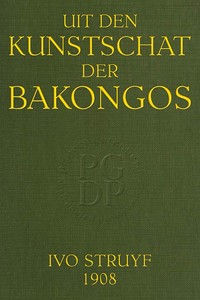
Uit den Kunstschat der Bakongos by Ivo Struyf
Published in the 1920s, this book is the work of Ivo Struyf, a Belgian missionary who spent decades in the Congo. On the surface, it's a catalog. Struyf carefully collected, drew, and described hundreds of objects made by the Bakongo people—masks used in ceremonies, finely carved figures, tools, musical instruments, and household items. He organized them, gave notes on their use, and presented them as a 'treasury' of art.
The Story
There isn't a traditional plot. The 'story' is the journey of the collection itself and the man behind it. Struyf arrived in Congo with a specific religious and cultural mission. Yet, as he lived there, something shifted. Instead of just seeing idols or curiosities, he began to see skill, spiritual depth, and a complex artistic tradition. The book is the proof of that shift. Each page, with its detailed illustrations and descriptions, represents a moment where he chose to look closer, to ask questions, and to preserve what he saw. The conflict is internal and historical: a European man in a colonial era, working within a system that often destroyed such cultures, deciding instead to document and honor their creative spirit.
Why You Should Read It
This book surprised me. It’s easy to approach old colonial-era texts with skepticism, and you should. But Struyf’s work feels different. His attention to detail is a form of respect. You can feel his genuine fascination in the careful lines of his drawings and in his attempts to explain the meaning behind a mask's shape or a symbol's pattern. It becomes a conversation across time—not just with Bakongo artists, but with Struyf himself. You're watching him learn. For me, the most powerful parts are the everyday objects. A beautifully woven basket or a decorated pot speaks volumes about a culture’s aesthetic being woven into daily life, not reserved for special occasions. It challenges the old-fashioned idea of what 'art' is and where it belongs.
Final Verdict
This is a special book for a specific reader. It's perfect for anyone interested in the intersection of art, anthropology, and colonial history. If you love peering into museum archives or are curious about how cultural understanding can emerge in unlikely places, you'll find it fascinating. It's not a fast-paced narrative; it's a slow, thoughtful study. Read it for the incredible artwork it preserves, and for the quiet, complicated story of the man who decided it was worth saving. It’s a piece of history that asks more questions than it answers, and that’s what makes it stick with you.
This work has been identified as being free of known copyright restrictions. It is available for public use and education.
Susan Thompson
1 month agoI stumbled upon this title during my weekend research and the clarity of the writing makes even the most dense sections readable. Thanks for making such a high-quality version available.
Christopher Thomas
7 months agoAs a professional in this niche, the structural organization allows for quick referencing of key points. I appreciate the effort that went into this curation.
Ashley White
1 year agoThis work demonstrates a clear mastery of contemporary theories.
Matthew White
6 months agoAs someone working in this industry, I found the insights very accurate.

Elizabeth Lee
1 year agoThis work demonstrates a clear mastery of contemporary theories.