
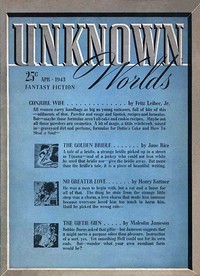
Conjure wife by Fritz Leiber
Fritz Leiber's Conjure Wife is a classic that feels anything but dusty. Published in 1953, it plants its eerie seeds in the most normal soil imaginable: a small college campus.
The Story
Norman Saylor is a sociology professor, a man of logic and reason. He's successful, well-liked, and happily married to Tansy. His world turns upside down when he accidentally discovers Tansy's secret stash: charms, powders, and little fetishes hidden around their home. She confesses she's been using protective magic for years to shield him from professional rivals and everyday malice. Horrified by this "primitive" superstition, Norman forces her to destroy everything and renounce her practices.
That's when the trouble starts. Almost immediately, Norman's life unravels. A promising promotion vanishes. A student files a bizarre accusation. Old friends turn hostile. Random accidents threaten him. As his rational world crumbles, Norman is forced to confront a terrifying possibility: what if the magic was real? What if every other faculty wife on campus is also a secret witch, and he's just made his wife disarm in the middle of an invisible war?
Why You Should Read It
What I love about this book is how it gets under your skin. Leiber isn't writing about gothic castles; he's writing about faculty teas, office politics, and marital trust. The horror comes from the idea that the person you share your life with might be operating on a set of rules you don't understand—and that your skepticism could be your biggest weakness. Tansy isn't a sinister figure; she's practical, loving, and fiercely protective. The real tension is in Norman's journey from arrogant disbelief to desperate belief. It's a brilliant exploration of how we rationalize the things we can't explain, and how much we rely on unseen support systems.
Final Verdict
Perfect for readers who like their chills served with a side of sharp social observation. If you enjoyed the domestic unease of Shirley Jackson or the idea-driven sci-fi of the mid-20th century, you'll find a lot to love here. It's a quick, gripping read that will make you look at your own relationships—and that little dust corner behind the dresser—with a whole new sense of wonder and suspicion. A true gem of paranoid, psychological horror.
You are viewing a work that belongs to the global public domain. You are welcome to share this with anyone.
Richard Johnson
11 months agoVery helpful, thanks.





Emily Williams
6 months agoI appreciate how this edition approaches the core problem, the historical context mentioned in the early chapters is quite enlightening. It definitely lives up to the reputation of the publisher.