
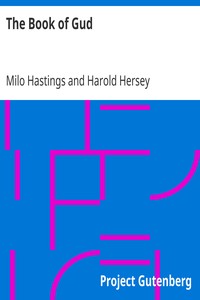
The Book of Gud by Milo Hastings and Harold Hersey
Let's get the premise straight. The Book of Gud isn't presented as a novel. It's framed as a scholarly discovery. Authors Milo Hastings and Harold Hersey act as 'editors' who've stumbled upon an ancient manuscript that tells the true story of Gud, the creator god. The whole book is this clever bit of make-believe, setting up the joke from page one.
The Story
The plot follows Gud himself. He creates the world on a whim, but he's immediately kind of disappointed with it. He's lonely, so he makes humans, but finds them frustrating. The story walks us through his misguided adventures and experiments with humanity. He tries to guide them, punish them, and connect with them, but it often backfires or leaves him feeling empty. It's less about epic battles and more about a powerful being dealing with boredom, pride, and the consequences of his own creations. Think of it as a series of mythical vignettes showing a god who is all-powerful but not all-wise.
Why You Should Read It
What grabbed me was the book's tone. It's not an angry attack on faith. It's sly and satirical, with a dry sense of humor. Gud isn't evil; he's just... relatable in his flaws. He gets jealous, he seeks praise, he makes mistakes. Reading it feels like getting insider gossip on mythology. The authors use this setup to ask big questions in a light way: Why do we imagine our gods as perfect? What if creation was an accident or a pastime? It makes you chuckle, then makes you think.
Final Verdict
This book is a hidden gem for a specific reader. It's perfect for anyone who enjoys early 20th-century satire, loves mythological retellings like American Gods but wants something older and quirkier, or has an interest in the history of unconventional religious thought. It's not a long or difficult read, but it packs a punch. If you're looking for a straightforward fantasy adventure or something that takes itself very seriously, look elsewhere. But if you want a clever, conversational, and thought-provoking poke at the divine, dig up The Book of Gud.
This historical work is free of copyright protections. You are welcome to share this with anyone.
Andrew Lee
4 months agoClear and concise.
Charles Brown
6 months agoComprehensive and well-researched.
Joseph Smith
1 year agoNot bad at all.
Richard Hill
1 year agoRecommended.







Linda Martin
1 year agoSolid story.