
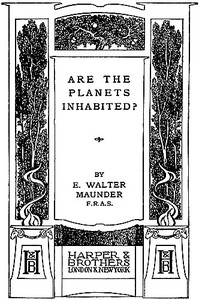
Are the Planets Inhabited? by E. Walter Maunder
Ever looked up at the stars and wondered if anyone was looking back? In 1913, that question was a national obsession, especially about Mars. Are the Planets Inhabited? is astronomer E. Walter Maunder's attempt to answer it with reason, not fantasy.
The Story
This isn't a story with characters and a plot. It's the story of an idea. Maunder systematically breaks down the big question. He starts by defining what we mean by 'life' and 'inhabited.' He then tours our solar system, planet by planet, using the science of his day. He explains why Venus's clouds probably make it a steamy hellscape, why Mercury is likely barren, and why the giant planets are probably not hosting anyone we'd recognize. The heart of the book is his famous takedown of the 'Mars canal' craze. He shows how the human eye and mind can connect random dots into false patterns, arguing that the 'canals' were likely an optical illusion. His conclusion? Life, especially intelligent life, is probably very, very rare.
Why You Should Read It
Reading this today is a thrill. You get to see the birth of modern astrobiology—the science of life in space. Maunder's method is his magic. He's cautious, humble, and brilliant at using Earth as a guide. When he talks about how a planet needs a stable climate for life, he points to Earth's ice ages. It makes the science feel grounded. You're not just getting his conclusions; you're following his thought process. It’s also a powerful lesson in skepticism. In an age flooded with sensational Martian stories, he urged people to demand better evidence. That message feels incredibly fresh now.
Final Verdict
This book is perfect for anyone who loves science history or the current search for exoplanets. It's for the curious person who enjoys seeing how a great thinker works through a problem step-by-step. If you want laser battles and alien diplomats, look elsewhere. But if you want to sit with a sharp, clear-minded guide from over a century ago and ponder one of humanity's oldest questions, you'll find Maunder's quiet, logical voice utterly captivating. It’s a classic that reminds us that good questions are often more important than quick answers.
This digital edition is based on a public domain text. Use this text in your own projects freely.
Christopher Moore
8 months agoI appreciate the objective tone and the evidence-based approach.
Ashley Perez
1 year agoGreat read!
Christopher Thomas
2 years agoSurprisingly enough, the author's voice is distinct and makes complex topics easy to digest. One of the best books I've read this year.
Ava Hill
2 years agoWithout a doubt, the content flows smoothly from one chapter to the next. Exactly what I needed.







Jennifer Hernandez
1 year agoHaving explored several resources on this, I find that the way the author breaks down the core concepts is remarkably clear. Thanks for making such a high-quality version available.