
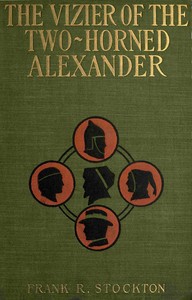
The Vizier of the Two-Horned Alexander — Story, Setting & Ideas

(0 User reviews)   585
Stockton, Frank R., 1834-1902 Project Gutenberg 2003 Not confirmed
Fantasy fiction; Adventure stories; Immortalism -- Fiction Readers of public-domain and historical texts
Project Gutenberg digital edition en

Edition facts

Words 41,556
Reading time 181 min
Text sections 4

For The Vizier of the Two-Horned Alexander — Story, Setting & Ideas, the stored edition analysis reports 41,556 words, 3 hr 1 min estimated reading time, and 4 detected text sections.

The text analysis averages about 21.1 words per sentence, while the detected sections provide another way to judge how the source is divided.

Project Gutenberg metadata also associates the work with “Fantasy fiction,” connecting these edition facts with the source record’s subject description.

Frank R. Stockton's 1899 novel follows an immortal narrator who, as vizier to the Two-Horned Alexander, recounts adventures spanning millennia. The story blends legendary history with personal memoir, using a shipwreck frame to introduce a character who has buried jewels in Roman catacombs and retrieved them centuries later.
Share
Editorial Edition Score 4.7/5

Calculated from edition completeness, EPUB availability, text structure and catalogue metadata. Not a user rating.

How this score is calculated
  • Description quality20 pts
  • Title & short description10 pts
  • Source metadata20 pts
  • Text length15 pts
  • Chapters / structure15 pts
  • EPUB file integrity20 pts

Total of 100 points, scaled to a 2.5-5.0 range. Editions with an empty description or a missing EPUB file are not scored.

Edition quality

Public-domain source text

Read the source text

The source text is kept in the dedicated reader, separate from this catalogue record and its commentary.

The story opens not in antiquity but on a French steamer bound from Havre to New York, where a collision with a derelict vessel forces passengers into lifeboats. This modern shipwreck serves as the frame for an extraordinary tale: one of the passengers, Mr. Crowder, begins to relate his experiences as the vizier of the Two-Horned Alexander—a monarch distinct from Alexander the Great, placed in the time of Abraham according to the prefatory note. Stockton grounds his fantasy in a specific source, the chronicles of Abou-djafar Mohammed Tabari, and signals that the narrator now feels safe to speak openly, a compliment to the age.

A Frame of Shipwreck and Conversation

The opening chapter establishes a contrast between the mundane danger of a foggy night at sea and the vast temporal scope of the story to come. The narrator, a passenger, describes the collision with a “great, heavy, helpless mass” and the hurried evacuation. This setting allows for a natural exchange between characters, and it is here that Mr. Crowder begins his account. The frame device is not merely ornamental; it creates a listener, Mrs. Crowder, whose interjections—such as “When did thee get them again?”—keep the narrative grounded in a present moment. Stockton uses this structure to bridge the reader’s world and the legendary past, hinting that the vizier’s story will unfold through dialogue rather than direct chronicle.

The Catacombs and the System of Threes

A central episode involves the concealment of jewels in the Roman catacombs. The narrator describes a meticulous plan based on a “series of three threes”: three transverse passages, three turns to the left, and three open tombs. This mnemonic system is presented with precise, almost procedural detail: “Starting from this opening, my plan was to proceed inward through the long corridor until I came to a transverse passage; to pass this until I reached another; to pass this also, and to go on until I came to a third.” The methodical description—digging a hole two feet deep with a dagger, smoothing the earth—contrasts with the romantic notion of hidden treasure. The jewels themselves are accompanied by parchment sheets written “with the fine ink the monks used,” linking the immortal’s story to manuscript culture and the preservation of history.

Time, Absence, and the Return

After burying the box, the narrator does not retrieve it for three hundred years. He travels to Constantinople, Greece, and Venice, living “very comfortably” without need of the jewels. When he finally returns to Rome in the early nineteenth century, he finds the catacomb entrance altered but still recognizable by its relation to “certain ruins and natural objects.” This gap of centuries is treated with casual understatement—a hallmark of the immortal’s perspective. The passage emphasizes the physical endurance of the hiding place and the narrator’s reliance on memory and landmarks. Stockton does not dwell on the emotional weight of such a return; instead, he focuses on the practical challenge of rediscovery, keeping the tone matter-of-fact even as the timescale stretches belief.

Readers should attend to the interplay between the frame narrative and the embedded memories. Stockton’s prefatory note insists on the historical basis of the Two-Horned Alexander, yet the story itself leans into the fantastic through the immortal narrator’s offhand chronology. The catacomb episode exemplifies the author’s method: grounding the extraordinary in concrete, almost technical description. As the vizier’s tale unfolds, the tension between legendary scope and domestic detail becomes the engine of the narrative.

In six thousand years, the vizier learns that time softens all sorrows, yet never erases them—much as a good laugh holds a tear at its edge. That quiet truth lingers in Stockton’s memoir and echoes, tenderly, in Humoresque: A Laugh on Life with a Tear Behind It — Themes and Context. Both know the weight of a jest carried over centuries.

There are no reviews for this eBook.

0
0 out of 5 (0 User reviews )

Add a Review

Your Rating *
There are no comments for this eBook.

Reader reflection

What did you think of this book?

Answer a few questions and save a private reflection on this device.

Your progress 0 / 10
1

Which reading stage best describes you?

2

How did the book work for you overall?

3

Would you pass this book on to a friend?

4

Did the language feel accessible?

Related eBooks