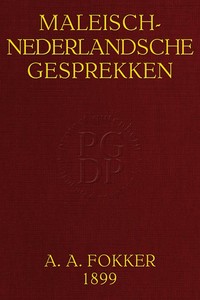
Maleisch-Nederlandsche Gesprekken by Abraham Anthony Fokker
Let's be clear from the start: this is not a storybook. You won't find heroes, villains, or a twisting plot. Abraham Anthony Fokker's Maleisch-Nederlandsche Gesprekken (Malay-Dutch Conversations) is exactly what the title says: a practical phrasebook. Published in 1897, it was a tool for Dutch colonists, officials, and businessmen to navigate daily life in the Dutch East Indies.
The Story
There's no narrative, but there is a setting: colonial Indonesia. The 'story' unfolds through dozens of scripted dialogues. A Dutchman bargains with a carpenter. A housewife instructs her cook. A plantation manager discusses workers' pay. A traveler hires a boat. The book walks you through transactions, complaints, and commands. It's a manual for existing within a rigid social and racial hierarchy, with the Dutch speaker always in the position of authority. The 'plot' is the business of empire, written in the plain language of market prices and domestic orders.
Why You Should Read It
This is where it gets interesting. The book's power lies in its sheer normality. Fokker wasn't writing a political manifesto; he was solving a practical problem. That's what makes it such a potent historical document. You see the colonial mindset not in grand speeches, but in the casual way a character might say, 'Tell the gardener he is lazy' or 'The coolies must work harder.' It reveals the day-to-day machinery of colonialism—how language itself was structured around command and control. Reading it, you're struck by the jarring contrast between the polite, instructional tone of the book and the oppressive reality it facilitated.
Final Verdict
This is a niche read, but a powerful one. It's perfect for history buffs, linguists, or anyone fascinated by how everyday tools can reflect big, difficult truths. If you're looking for a traditional novel, look elsewhere. But if you want to understand history from the ground up—from the conversations on a veranda or in a market—this phrasebook offers a window like no other. It's a quiet, unsettling, and completely authentic look at a vanished world, reminding us that history is often written in the most ordinary of words.